Image from: (opens in a new window)van Rooij et al. (2024). Used under (opens in a new window)GNU General Public Licence v3.0.
MSc in Cognitive Science
Cognitive Science is the interdisciplinary study of minds, brains and behaviour. Many disciplines contribute to this overarching goal, including, but not restricted to, philosophy, psychology, Artificial Intelligence, robotics, neuroscience, linguistics, and anthropology, with each discipline making its own distinctive contribution.
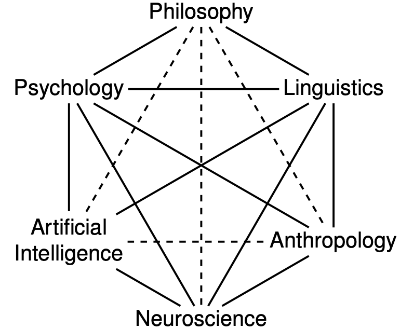 The MSc in Cognitive Science is ideal for students interested in issues relating to the understanding of the human mind from philosophical, psychological, and computational perspectives. Students will have the opportunity to become familiar with the problems arising in the description of minds, brains, and behaviour, and the theoretical approaches to them, learn the principal 20th-Century philosophical approaches to mind, brain and body, understand the concepts employed in cognitive psychology, along with their limitations, and develop an interdisciplinary perspective that links and integrates insights from multiple specialised domains.
Please note: Cognitive Science should not be confused with Cognitive Behavioural Therapy. Our degree programme are not a preparation for a counselling qualification, and are not part of any accredited psychological career pathway.
Programme Content and Structure (2025/26)
The programme may be taken in one year (full-time) or two years (part-time), during which time students take from between six to eight taught modules (up to a minimum of 60 credits), selected as follows.
(A) Core Module (1)
One core module, compulsory for all students on the programme, in the Autumn trimester. Note: part-time students must take this module in their first year.
- COMP47230 Introduction to Cognitive Science (7·5 credits)
(B) Option Modules (6–7)
Students must select at least 52·5 credits from the following list. Further details about current Computer Science modules may be found here; details about current Philosophy modules may be found here.
Autumn Trimester
- COMP40250 Introduction to Cognitive Psychology (7·5 credits)
- PHIL40970 Topics in Philosophy of Mind & Cognition (10 credits)
- PHIL40250 Merleau-Ponty’s Phenomenology of Perception (10 credits)
- PHIL41320 Topics in Continental Philosophy (10 credits)
- PHIL41510 Ethics in Public Life (10 credits)
- PHIL41890 Authenticity & Implicit Attitudes (10 credits)
- PHIL31030 Philosophy of Perception & the Senses (10 credits)
- PSY40020 Fundamentals of Cognitive Neuropsychology (7·5 credits)
Spring Trimester
- COMP20330 Functional Programming II (5 credits)
- COMP40260 Connectionism & Dynamical Systems (7·5 credits)
- COMP40280 Embodied & Enactive Approaches to Cognitive Science (7·5 credits)
- COMP47980 Generative AI: Language Models (5 credits)
- PHIL40960 The Cultural Mind (10 credits)
- PHIL31110 Applied Epistemology (10 credits)
- PHIL31120 Wittgenstein (10 credits)
- PHIL31170 Philosophy of Language (10 credits)
- SOC41130 AI & Society (10 credits)
Please note: the programme structure and list of available modules may change from year to year. Some of the above modules may not run in 2026/27, in which case additional options will be made available.
Consult with the programme directors if you are unsure how many modules or credits to take, or if you are unsure whether a particular module is suitable for you.
(C) Research Project
In addition, all students must complete an independent research project, including a literature review (6 to 10 pages), a short presentation, and final paper (10–20 pages) by mid-August. Students are encouraged to discuss possible topics with their lecturers as early as possible.
Part-time students must complete the research project in their second year.
(opens in a new window)Entry Requirements for Taught MSc Programme
Applicants must demonstrate an adequate foundation in themes of relevance to Cognitive Science. This usually takes the form of a BA/BSc degree in one or more of the main contributing disciplines—Philosophy, Psychology, Neuroscience, Linguistics, or Computer Science—with a final award of 2:1 or better (GPA of approx. 3·2), or international equivalent.
All applications are assessed on a case by case basis, however, so students with a non-standard background may also wish to consider applying. Advanced computational skills are not a prerequisite for this programme.
Important: Applicants must display familiarity and critical engagement with some aspect of Cognitive Science. A degree in Computer Science that is focused on software engineering alone, for example, would not be considered adequate preparation, whereas the same degree with evidence of theoretical proficiency in robotics or human-computer interaction would be appropriate. Similarly, applicants with a background in Psychology would be expected to demonstrate critical engagement with the theoretical aspects of cognitive science, and not only clinical psychological practice.
Required Application Documents and What We Look For
- Two academic references: These should be from academic referees who can speak to your promise as an MSc student. Referees may send their letters directly to (opens in a new window)philosophy@ucd.ie or you can upload them to the portal, depending on your referees’ preference. (Alternatives may be possible for applicants whose primary degree was more than five years ago.)
- Sample of academic writing: An essay or paper of up to 3,000 words; for example, an undergraduate essay submitted as part of your undergraduate degree on a scientific or philosophical topic of your choice. We assess the quality of arguments, intellectual maturity, and clarity of style.
- Statement of personal interest: A short statement (maximum 1,000 words) explaining your motivation for further study, your research interests, and reasons for applying to UCD’s School of Philosophy.
- Academic transcripts: Official transcripts for all university-level study. These help us to evaluate your coursework performance, grades, and consistency of achievement.
- Proof of English language proficiency: Fluency in written English is required. If you are not a native speaker of English and your secondary education or university degree has not been carried out in English, then you must submit evidence of either a TOEFL score of 600 or an IELTS score of 6·5 overall, minimum 6·0 in each band. These represent an absolute minimum and have to be strictly enforced as the programme requires a lot of written work and reading in primary literature in a variety of fields, including philosophy. See this page for further details.
Candidates may be invited to an online interview with one of the Programme Directors and another member of the faculty.

Contacts
For academic enquiries, please contact the Programme Directors at cogsci@ucd.ie. All administrative enquiries should be sent to the School Manager.

Travis Grotewold
Postgraduate Programme Administrator
(Computer Science, 2025/26)
Office:

Gillian Johnston
School Manager | Graduate Administrator (Philosophy)
Office:



UCD School of Philosophy
Room D501 (5th Floor), Newman Building, UCD Belfield, Dublin 4, Ireland T: +353 1 716 8186 | E: philosophy@ucd.ie | Location Map(opens in a new window)UCD Philosophy is ranked among the Top 100 Departments of Philosophy worldwide (QS World University Rankings 2017, 2018, 2021, 2023–2025)