- Text Alternatives for Non Text content: Most non-text content presented to the user in the product has text alternatives that serve the equivalent purpose (1.1.1 Non-text Content (Level A)).
- In most instances, the product ensures that information, structure, and relationships conveyed through presentation can also be determined programmatically or through text (1.3.1 Info and Relationships (Level A)).
- In most instances, the product does not use color as the only visual means of conveying information, indicating an action, or prompting a response (1.4.1 Use of Color (Level A)).
- In most instances, the visual presentation of text and images of text in the product provides a contrast ratio of at least 4.5:1 against adjacent colors (1.4.3 Contrast (Minimum) (Level AA)).
- Web: In most instances, the product contains user interface components whose name, role, state, and value can be programmatically determined (4.1.2 Name, Role, Value (Level A)).
- The product uses headings and labels that describe their topic or purpose in most instances (2.4.6 Headings and Labels (Level AA)).
- In most instances, the product provides status messages that can be presented to assistive. technologies without receiving focus (4.1.3 Status Messages (Level AA 2.1 only).
Accessibility Statement for Turnitin
University College Dublin (UCD) is committed to making its plagiarism detection tool Turnitin accessible, in accordance with the European Union (Accessibility of Websites and Mobile Applications of Public Sector Bodies) Regulations 2025.
This accessibility statement applies to Turnitin iThenticate, originality checking tool for academic publications (Version 1 as on Date 20 June 2025) hosted by University College Dublin.
Getting the most from this site
iThenticate is a research integrity solution designed for academic researchers, publishers, institutions and wider organisations to ensure the originality of written work by comparing it against a (opens in a new window)vast database of scholarly and non-scholarly content. The tool is accessible to UCD academic staff and research students and can be accessed via UCD Connect site only.
The tool produces text based reports and it is designed to be largely operable through a keyboard interface, allowing users to navigate most content without a mouse and avoiding keyboard traps. It supports users with low vision by permitting text resizing up to 200% and generally reflowing content to avoid two-dimensional scrolling, while also providing "skip links" to bypass repeated navigation blocks. Users might find some tool limitations with the MY FILES interactive structure and also Upload button. Additionally, minor inconsistencies in focus order may occur after actions like submitting the "Sign In" form.
For more information contact UCD Access & Lifelong Learning: (opens in a new window)all@ucd.ie
Compliance status
iThenticate is partially compliant with the Web Content Accessibility Guidelines (WCAG) 2.2 Level A and AA due to some partial compliance identified below:
- In most instances, the product ensures that information, structure, and relationships conveyed through presentation can also be determined programmatically or through text (2.1.1 Keyboard (Level A)).
- Most pages of the product provide titles that adequately describe their topic or purpose (2.4.2 Page Titled (Level A)).
- In most instances, pages of the product can be navigated sequentially with a focus order that matches the logical reading order (2.4.3 Focus Order (Level A)).
- In most instances, the product ensures that when interface components have visual labels that include text, the provided accessible name contains the visually presented text (2.5.3 Label in Name (Level A 2.1 only)).
- In most instances, the product provides a visible indication of keyboard focus for elements of each age (2.4.7 Focus Visible (Level AA)).
- The product ensures that most interactive components do not initiate a change in context when the component setting is changed unless followed by an explicit user action such as activation of a button or link (3.2.2 On Input (Level A)).
- In most instances, where the product automatically detects input errors, the item or field in error is identified and the error is described to the user in text (3.3.1 Error Identification (Level A)).
- In most instances, the product allows text to be resized without assistive technology up to 200 percent without loss of content or functionality (1.4.4 Resize text (Level AA)).
- In most instances, pages of the product allow for resizing to a minimum width of 320 CSS pixels or vertical height of 256 CSS pixels without loss of content or functionality, and without requiring scrolling in two dimensions except where scrolling is required for two-dimensional content such as tables, diagrams, or maps (1.4.10 Reflow (Level AA 2.1 only)).
- In most instances, the visual presentation of non-text content in the product has a contrast ratio of at least 3:1 against adjacent color(s) (1.4.11 Non-text Contrast (Level AA 2.1 only)).
- In most instances, content triggered by hover or focus remains visible while triggered, remains visible while moving the pointer over it, and can be dismissed without moving the pointer or changing focus if it obscures other content (1.4.13 Content on Hover or Focus (Level AA 2.1 only)).
- In most instances, where user input is required, the product presents adequate labels or instructions for successfully providing that input (3.3.2 Labels or Instructions (Level A)).
- In most instances, the product ensures that the purpose of input fields that request information about the user, such as name or email, can be programmatically determined (1.3.5 Identify Input Purpose (Level AA 2.1 only)).
Advanced Technical Information
For information on accessibility features please go to the following link:
(opens in a new window)https://www.turnitin.com/accessibility/#
Evaluation Methods
Evaluation of the product involved a combination of automated, manual, and functional testing against the applicable success criteria within the Web Content Accessibility Guidelines (WCAG) 2.2 Conformance Levels A and AA. Level Access (Level) tested a selection of the product using a representative sample to cover the components and functionality of use flows. Below is a list of the assistive technologies (ATs) used: • NVDA/Chrome
Content not in scope of this documentation
- third-party content
- reproductions of items in heritage collections that cannot be made fully accessible
Preparation of this accessibility statement
This statement was prepared by UCD IT Services at University College Dublin on 09 October 2025 June 2025
Version 1 published
Feedback and contact information
If you have any concerns in relation to how the IThenticate is compliant with the Web Content Accessibility Guidelines (WCAG) 2.2 Level A and AA we would appreciate it if you could contact UCD IT Services as a first port of call to discuss any concerns by logging a call via www.ucd.ie/ithelp and selecting “Get Help”.
iThenticate Turnitin
UCD strives to be a model of inclusion. We respect and value student diversity in all the modules we offer. Our learning environment is designed inclusively, so that it can be accessed, understood, and used to the greatest extent possible, removing all barriers. Students are provided with equal opportunities to access, participate, and succeed, regardless of background, personal circumstances, age, disability, or pace of study. UCD is a university for all where diversity and inclusion are woven into the fabric of our institution at every level. Students are encouraged to approach staff to discuss their learning needs. Any information disclosed will be treated with confidentiality and respect (UCD 2022c).
Students with documented disabilities can register with the UCD Access office - disability@ucd.ie. Please try to alert Module Coordinators if you need any specific accommodation at the start of the module. Students without documented disabilities who may need accommodations can discuss this with Module Coordinators privately or set a meeting to discuss specific needs (UCD 2022d).
Enforcement procedure
If you experience barriers in accessing this platform or its content and are not satisfied with the way we respond to support your access, you can contact,
- UCD IT Services - www.ucd.ie/ithelp
- UCD Access and Lifelong Learning - https://www.ucd.ie/all/aboutus/contact/
- The Office of the Ombudsman -
(opens in a new window)Contact Ombudsman |Advice on (opens in a new window)making a complaint under the Disability Act
The Workplace Relations Commission -
(opens in a new window)Contact Workplace relations | Advice on (opens in a new window)making a complaint under the Equal Status Act
How we are improving accessibility
University College Dublin has invested in digital accessibility in the following ways.
- Ensuring accessibility is a key criterion in all digital procurement.
- Investing in the ALLY system to provide automated accessibility checking and reporting of both our digital platforms and the content uploaded to them.
- Optional staff training and development in digital accessibility practices.
Further Support
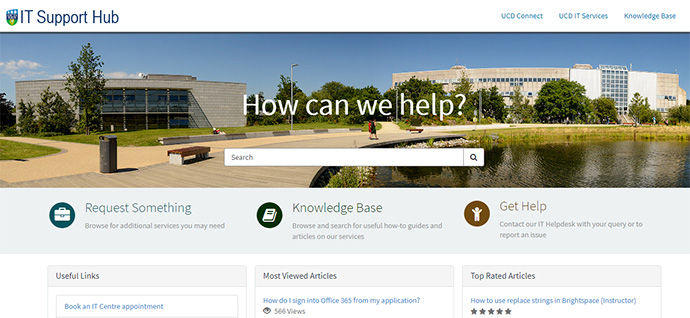
The UCD IT Support Hub is where you can log a call with our UCD IT Helpdesk team, find an answer in our Knowledge Base of articles, or request an additional service or access.
UCD IT Services
Computer Centre, University College Dublin, Belfield, Dublin 4, Ireland.Contact us via the UCD IT Support Hub: www.ucd.ie/ithelp